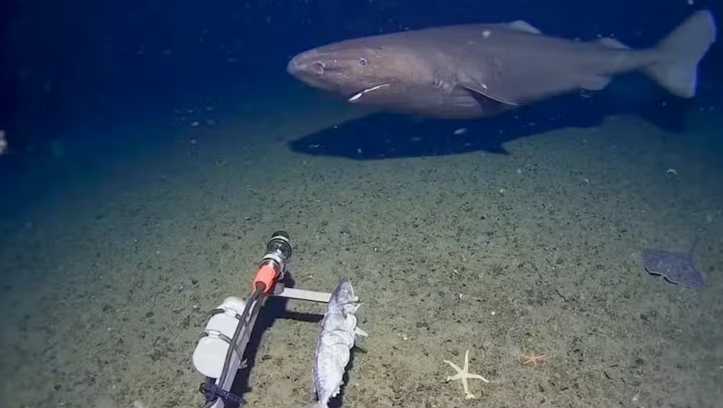
The team estimated the individual to be about 3.5 meters long, although these sharks can grow up to seven meters. Sleeper sharks have existed for hundreds of millions of years and inhabit nearly all the world's oceans, but their presence near the South Pole is uncommon. So far, most of the available information comes from accidental catches during fishing activities. A sleeper shark was filmed for the first time near the Antarctic Ocean during a scientific expedition in January. This unusual record was made at a depth of 1,400 meters and in waters with a temperature of about 1°C, according to the University of Western Australia. This discovery was made as part of a biodiversity exploration in the Tonga Trench, in the southwest Pacific Ocean. They move at very low speeds in deep waters. Researchers from the Minderoo Deep-Sea Research Center used an underwater camera to capture the specimen while it was feeding on bait. The footage shows the shark opening its mouth and displaying several rows of teeth. The dentition of this species has not yet been defined. These are large sharks with spotted skin and small fins. They can live from the surface to thousands of meters in depth. This characteristic allows them to save energy in cold and dark environments. Experts are trying to determine if the species will be able to expand into more areas of Antarctica as ocean temperatures rise due to climate change. The species' name reflects its behavior.